Stop Asking, "Quality or Quantity." Ask "Which Platform."
"Post quality over quantity" ignores the one thing that decides how often you should post: the platform. Here is why cadence is a per-platform decision.
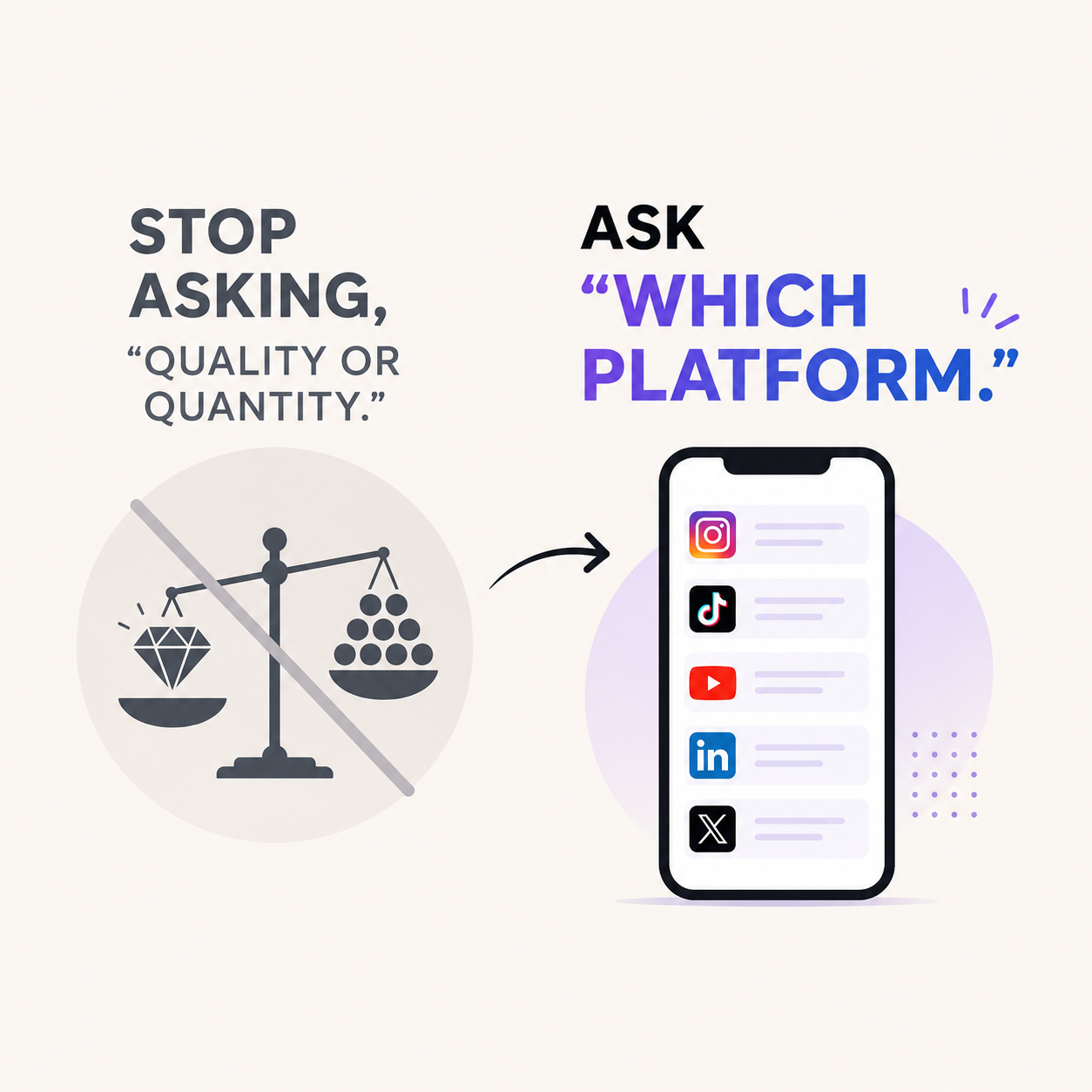
Stop Asking "Quality or Quantity." Ask "Which Platform."
There is a piece of advice that circulates in every marketing conversation: post quality over quantity. It sounds wise. It is also, on its own, useless, because it ignores the one thing that actually decides how often you should post: the platform you are posting on.
The people who succeed at content do not follow a universal rule about frequency. They read the mechanics of each platform and let those mechanics set the cadence. On some platforms, posting more is a competitive advantage. On others, the same behaviour destroys your reach.
Here is how to tell the difference.
Why quantity wins on YouTube Shorts and TikTok
Short-form video platforms run on a testing engine. When you post, the algorithm shows your video to a small sample of viewers and watches how they respond. If they finish it, if they rewatch it, if they share it, the platform widens the audience. If they scroll past, it stops.
This is why volume is an advantage here. If you post three to five videos across a day, spaced an hour or so apart, you are giving the algorithm multiple variants to test. It will find the one that performs and push that one hard. You are not diluting your presence; you are running experiments, and more experiments mean more chances to land a winner. On these platforms, restraint costs you data.
Why completion rate, not length, is the real target
Here is the detail most creators miss. On short-form video, the metric that matters is completion rate: the percentage of the video a viewer actually watches. A thirty-second video that holds attention for the full thirty seconds signals a 100 percent completion rate, and that is one of the strongest signals you can send. The platform reads it as: people wanted all of this, show it to more people.
So the goal is not to make the longest video you can. It is to match the length of your video to the attention your audience actually gives you. If viewers reliably stay for thirty seconds, a thirty-second video will perform to its ceiling. Stretch that same idea to ninety seconds, and your completion rate collapses, and with it your reach.
Why LinkedIn punishes the same behaviour
Now take that exact strategy to LinkedIn and it backfires. LinkedIn is not a rapid testing engine for volume; it is a professional feed built around a smaller, slower, more deliberate audience who see your name repeatedly. Post three to five times in a day here and you do not get five experiments. You get audience fatigue. The same people see you crowding their feed, engagement drops, and LinkedIn reads that drop as a signal to show you less.
Watch time tells the same story. Average watch time on a LinkedIn video often sits around ten to fifteen seconds, not the thirty-plus you might hold on to on Shorts. That is not a flaw to complain about; it is an instruction. It means the LinkedIn video should be cut to land its point inside that window. A video built for a thirty-second attention span will be abandoned halfway on LinkedIn, and a half-watched video is a weak signal, not a strong one. Study your LinkedIn Audience then determine the appropriete length.
The actual rule
The lesson is not "quality beats quantity". The lesson is that cadence and format are decisions you make per platform, using two questions: does this platform reward volume by testing my content, and what watch time does my audience actually give me here?
On YouTube Shorts and TikTok, that answer favours more videos, matched tightly to completion rate. On LinkedIn, it favours fewer, higher-signal posts, cut to a shorter attention span. Same creator, same message, two completely different playbooks. The professionals are not choosing between quality and quantity. They are refusing to apply one rule to platforms that were built to reward opposite behaviour.