Backend Infrastructure Explained: Supabase, Self-Hosting, and Choosing the Right Architecture for Web Applications
Choosing the right backend infrastructure is about more than technology. Explore Supabase, self-hosting, Nhost, Appwrite, Firebase, and custom architectures, including lessons from Mietric ERP, to understand the benefits, trade-offs, and when each approach makes sense for web application development.
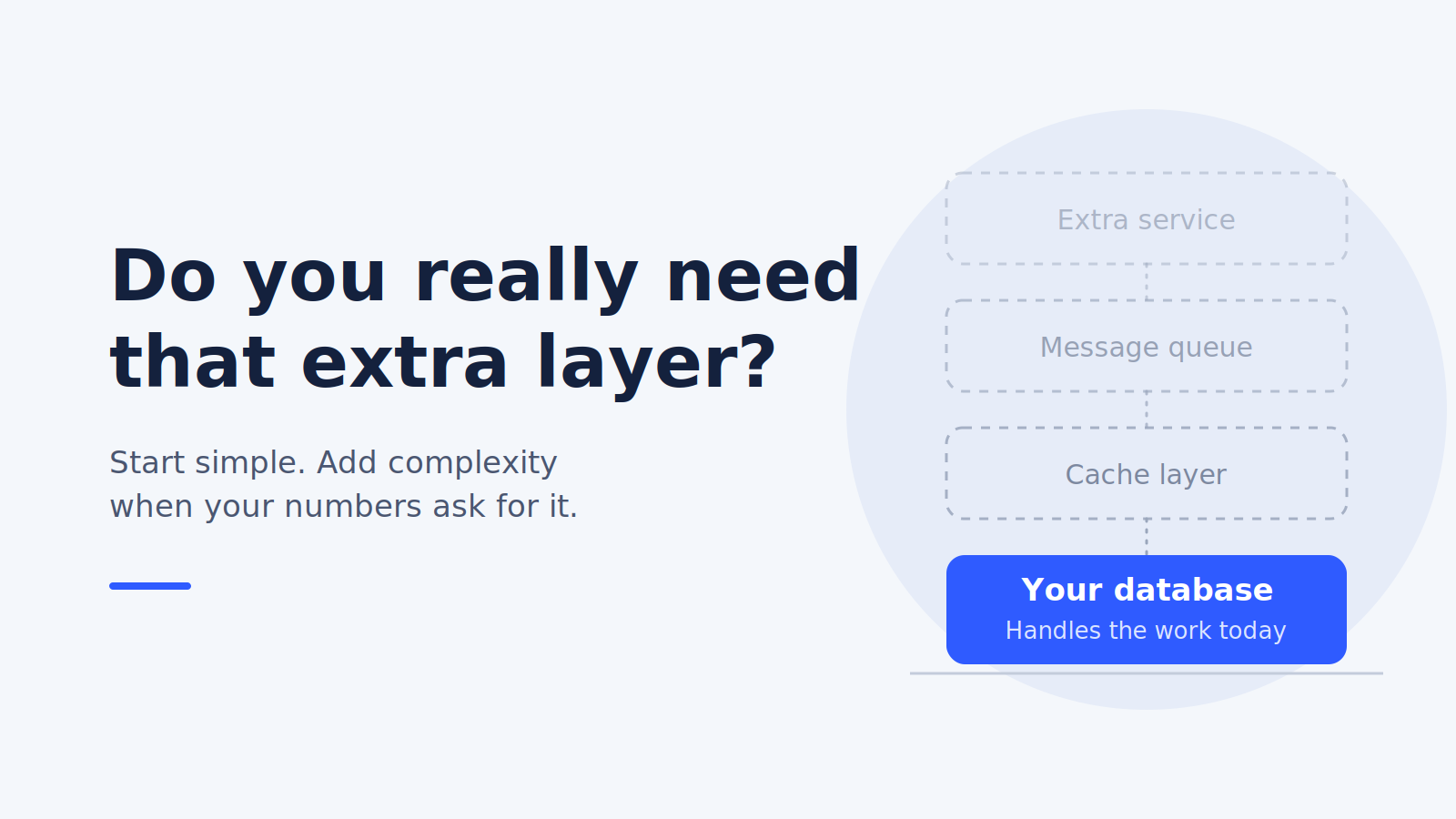
Should you build your own backend infrastructure, use Supabase, or choose an alternative such as Appwrite, Nhost, or Firebase? Understanding the trade-offs can save development time, reduce unnecessary complexity, and improve long-term reliability.
When developing a web application, much of the attention naturally goes to what users can see: the interface, dashboards, navigation, and overall experience. But behind every functional application is an infrastructure responsible for processing requests, managing data, authenticating users, and keeping operations running.
This is the backend infrastructure.
Today, developers can build their own backend, use a managed platform such as Supabase, or deploy an open-source backend platform on infrastructure they control. Each approach offers advantages, but each also introduces responsibilities that are often overlooked.
The question is not necessarily which backend technology is the most powerful. It is which architecture best supports the application's requirements, available resources, and long-term operational needs.
What Is Backend Infrastructure in Web Development?
Backend infrastructure refers to the technologies, services, and computing resources that support an application's server-side operations. It processes requests from the frontend, applies business rules, communicates with databases, manages authentication, and coordinates other services required by the application.
Consider a web-based enterprise resource planning (ERP) system. When a user submits an expense request, the backend may need to verify their permissions, validate the request, store the transaction, initiate an approval workflow, and notify the relevant manager.
Although the user experiences this as a single action, several backend components may be involved.
A typical backend architecture includes an application server or API, a database, authentication and authorization mechanisms, file storage, background task processing, and networking components. Production applications also need monitoring, backups, security controls, and recovery procedures.
Not every application requires all these components as separate services. A relatively simple application might perform most of its operations through one server, while a larger system may distribute responsibilities across multiple services.
The purpose of backend architecture is not to introduce as many technologies as possible. It is to support the application's requirements with an appropriate level of complexity.
Managed Backends, Self-Hosted Platforms, and Custom Backends: What's the Difference?
Before comparing individual technologies, it helps to distinguish two separate decisions: how a backend is designed and who operates its infrastructure.
A Backend as a Service (BaaS) platform provides common backend capabilities, such as databases, authentication, storage, and APIs, without requiring developers to build every component independently.
A self-hosted backend runs on infrastructure that the developer or organization operates, whether that is a local server, dedicated machine, or virtual private server (VPS) from a cloud provider.
A custom backend is an application-specific server-side architecture designed around its own business requirements, using technologies such as Node.js, PostgreSQL, Python, or other frameworks.
These approaches are not mutually exclusive. A developer can use Supabase as a managed service, self-host Supabase, build a custom backend on a VPS, or combine a custom API with a managed database.
Understanding this distinction helps avoid an important misconception: self-hosting does not automatically mean developing every backend component from scratch.
Supabase: A Ready-Made Backend Infrastructure
Supabase is an open-source backend development platform built around PostgreSQL. It brings together a relational database, authentication, automatically generated APIs, file storage, realtime capabilities, and server-side functions.
Instead of independently configuring these services, developers can use Supabase to establish much of their application's backend foundation.
For example, imagine developing a platform where community members register, access educational resources, and track their learning progress. Supabase could manage user authentication, store learning records in PostgreSQL, provide APIs for accessing information, and handle file storage.
This can significantly reduce the time required to build the initial product.
Benefits of Using Supabase
One of Supabase's biggest advantages is development speed. Common backend requirements are already available, allowing developers to concentrate on application-specific features rather than repeatedly implementing authentication, database APIs, and storage services.
Its PostgreSQL foundation also provides a familiar relational data model, making it suitable for applications where relationships, transactions, and structured records matter.
Supabase can be particularly attractive for startups, prototypes, SaaS products, internal applications, and mobile platforms. However, its built-in services do not eliminate the need to design data access rules, business logic, security controls, or efficient database queries.
When Should You Use Managed Supabase?
Managed Supabase makes sense when your priority is delivering application features without operating the underlying backend services yourself.
It can also be appropriate for production systems, provided the architecture, security, performance requirements, and platform limits have been evaluated. It is not exclusively a prototyping solution.
The trade-off is dependence on the managed platform for certain operational capabilities, alongside usage-based costs and service-specific constraints.
Self-Hosting Supabase: Greater Infrastructure Control
Supabase also supports self-hosting, meaning developers can run its backend services on their own infrastructure, commonly using Docker.
This approach combines the convenience of an integrated backend platform with greater control over its deployment environment.
Why Self-Host Supabase?
Infrastructure and data control. Self-hosting provides more control over where services run, how databases are configured, and how the deployment interacts with other systems. This may be important for organizations with particular data residency or operational requirements.
Customization and integration. Developers can configure network access, connect internal services, and integrate Supabase with existing infrastructure more directly.
Potential cost efficiency. For some applications with stable workloads, self-hosting may reduce recurring platform charges, particularly where suitable infrastructure and operational expertise already exist.
Reduced dependence on managed hosting. Hosting the open-source stack yourself gives you additional deployment flexibility, although your application can still depend on Supabase-specific APIs and components.
These benefits must be considered alongside operational responsibility.
With self-hosting, the developer becomes responsible for server administration, security updates, PostgreSQL maintenance, monitoring, backups, availability, and disaster recovery.
Importantly, the self-hosted Supabase stack is not identical to its managed cloud offering. Features such as managed backups, point-in-time recovery, and certain platform management capabilities are not automatically included.
A VPS costing less than a managed subscription does not necessarily mean the application is cheaper to operate. Engineering time, maintenance, recovery planning, and downtime risks are also costs.
For more detail, see the official Supabase self-hosting documentation.
Building a Custom Self-Hosted Backend: The Mietric ERP Example
Another approach is to design the application's backend around its specific operational requirements rather than adopting an entire Backend as a Service platform.
An example is Mietric ERP, an enterprise resource planning system designed for mission-driven organizations.
Mietric uses a custom backend architecture involving Node.js, PostgreSQL, Prisma, Nginx, PM2, and background job processing through pg-boss.
These technologies perform distinct responsibilities. Nginx routes incoming web traffic, Node.js executes application logic, Prisma provides structured database access, and PostgreSQL stores relational information. PM2 manages application processes, while pg-boss coordinates background tasks through PostgreSQL.
For an ERP system handling grants, financial records, procurement, operational approvals, and organizational workflows, the value of a custom backend lies in the ability to design business rules and data relationships around the actual product.
Benefits of a Custom Backend
A custom architecture provides greater freedom over application logic, database structures, service boundaries, integrations, and workflow processing.
For example, an ERP system may require a financial transaction to pass through multiple approval stages before it becomes final. This business logic can be designed directly into the application rather than being constrained by the abstractions of a particular backend platform.
Custom architectures also allow developers to choose individual technologies based on their requirements. If a PostgreSQL-backed job queue such as pg-boss is sufficient, introducing Redis solely because it is popular may add unnecessary infrastructure.
However, controlling the architecture is not the same as guaranteeing good performance.
Background workers can prevent long-running operations from blocking normal web requests, but when those workers run on the same VPS, they still consume the server's CPU, memory, and other resources. Effective workload management requires concurrency limits, database optimization, monitoring, and capacity planning.
When Does a Custom Backend Make Sense?
A custom backend becomes particularly useful when an application has complex business rules, specialized integrations, detailed authorization requirements, or workflows that do not fit neatly into a ready-made platform.
It can also make sense when an organization already has the technical ability to operate its infrastructure and wants direct control over how its systems evolve.
The disadvantage is that the development team assumes more responsibility for engineering, deployment, security, maintenance, and long-term support.
For Mietric, the architectural consideration is therefore not simply whether a custom backend is more powerful than Supabase. It is whether that level of control is justified by the application's operational requirements.
Other Backend Platforms Worth Considering
Supabase is only one option. Several other platforms provide backend capabilities using different architectural approaches.
Nhost: A PostgreSQL Backend Built Around GraphQL
Nhost combines PostgreSQL, GraphQL APIs, authentication, file storage, and serverless functions. Its architecture uses Hasura to expose GraphQL capabilities over PostgreSQL.
Nhost is particularly attractive when an application benefits from GraphQL's ability to request related data through a structured query interface.
For example, a dashboard that displays organizations, users, projects, and associated records may benefit from retrieving related data through GraphQL rather than coordinating numerous separate API requests.
Nhost offers managed infrastructure, and its open-source stack can also be self-hosted.
The main consideration is whether GraphQL fits the team's expertise and application requirements. For projects already structured around conventional REST APIs, introducing GraphQL may provide limited value relative to the additional learning and operational complexity.
Appwrite: An Integrated Backend Platform for Web and Mobile Apps
Appwrite provides authentication, databases, file storage, functions, realtime communication, messaging, and related developer services.
It supports both managed cloud deployments and self-hosting, making it an alternative for teams that want integrated backend functionality without constructing each service independently.
Appwrite can be particularly useful for web and mobile applications requiring user accounts, document management, notifications, and application APIs.
Its integrated developer experience can simplify common application workflows. However, it also introduces platform abstractions and operational requirements that developers should evaluate before committing to a deployment model.
Self-hosted Appwrite is a substantial service stack, not simply a lightweight database installation.
PocketBase: A Lightweight Backend for Smaller Applications
PocketBase offers a different approach to backend development. It combines an embedded SQLite database, authentication, file handling, realtime subscriptions, and an administration interface in a compact application.
Unlike platforms built around multiple containerized services, PocketBase can be straightforward to deploy and operate for smaller projects.
It can be useful for internal tools, prototypes, compact web applications, and projects where minimizing infrastructure overhead is important.
However, PocketBase primarily scales vertically on a single server. Its documentation also cautions that, while it remains under active development before version 1.0, it is not recommended for production-critical applications unless developers are prepared to handle possible compatibility changes.
This makes it important to distinguish lightweight deployment from universal production suitability.
Firebase: A Fully Managed Backend Ecosystem
Firebase is Google's managed application development platform, offering services such as Authentication, Cloud Firestore, Cloud Storage, and Cloud Functions.
Firebase is especially useful when developers want to build web or mobile applications without managing servers and need tight integration with Google's cloud ecosystem.
Cloud Firestore uses a NoSQL document model, which differs from the relational PostgreSQL approach used by Supabase and Nhost.
That distinction matters when designing applications with complex relationships, reporting requirements, and transactional workflows. Firebase can support sophisticated systems, but its data model and service architecture need to match the application's requirements.
Firebase's managed services reduce infrastructure administration, while usage costs, service limits, and dependence on its ecosystem require attention as applications grow.
Supabase vs Appwrite vs Nhost vs PocketBase vs Firebase: Which Should You Choose?
There is no universal winner. Each platform makes different trade-offs between development speed, flexibility, database architecture, operational complexity, and control.
A practical starting point is to match the backend approach to the problem:
- Choose Supabase when you want a PostgreSQL-based backend with integrated authentication, APIs, storage, and realtime features.
- Choose Nhost when PostgreSQL and GraphQL are central to your application architecture.
- Choose Appwrite when you want integrated backend services for web or mobile applications, with cloud and self-hosting options.
- Consider PocketBase when the application is relatively lightweight, a single-server deployment fits, and its maturity limitations are acceptable.
- Choose Firebase when managed infrastructure and integration with Google's application services align with your needs.
- Consider a custom backend when specialized workflows, authorization rules, integrations, or operational requirements justify greater architectural control.
These are starting points, not rigid rules. An application built with Supabase can still include custom business logic, and a custom Node.js application can use managed PostgreSQL, authentication, or storage services.
The best architecture is often a combination of technologies rather than an exclusive commitment to one platform.
Can You Combine Supabase With a Custom Backend?
Yes. In fact, hybrid architectures can offer a useful balance between development speed and control.
A developer might use Supabase for PostgreSQL, authentication, and storage while building a separate Node.js backend to handle complex workflows, integrations, and background processing.
Alternatively, an organization might self-host PostgreSQL and its application servers while relying on external managed services for functions such as email delivery or object storage.
The advantage is flexibility. Developers can select managed services where they reduce operational burden and implement custom components where business requirements demand greater control.
The risk is that combining services also introduces integration complexity. Teams need to understand which component owns each responsibility, how authentication and permissions are enforced, and how failures are handled across services.
A hybrid architecture is valuable when it removes unnecessary work, not when it creates an unnecessarily complicated collection of technologies.
Does Self-Hosting Make a Web Application More Secure, Faster, or Cheaper?
Not automatically.
Self-hosting gives developers control over infrastructure, but that control comes with responsibility. A self-hosted application without reliable backups, secure configurations, access controls, monitoring, and an update process may be more vulnerable than an appropriately configured managed service.
The same principle applies to performance. A well-optimized application on a modest VPS can perform effectively for its workload, while a poorly designed application on expensive infrastructure can still experience bottlenecks.
Scalability also depends on how the system is engineered. Database indexing, efficient queries, connection management, background job limits, caching, and resource monitoring often matter more than the hosting label alone.
Cost comparisons should therefore include more than monthly subscription fees. Infrastructure charges, engineering effort, security maintenance, backup storage, incident response, and recovery capabilities all contribute to the real cost of ownership.
This is where backend decisions become business decisions rather than purely technical preferences.
Frequently Asked Questions About Backend Infrastructure
What is the best backend infrastructure for a web application?
The best backend depends on the application's database requirements, business logic, expected workload, development capacity, security needs, and available budget. Managed platforms can accelerate development, while custom architectures can provide greater control over specialized requirements.
Is Supabase a complete backend?
Supabase provides many common backend services, including PostgreSQL, authentication, APIs, storage, realtime capabilities, and functions. Applications may still require custom business logic, integrations, background workers, and additional operational components.
Can Supabase be hosted on a VPS?
Yes. Supabase supports self-hosting using Docker, allowing developers to run its services on a compatible VPS or other server infrastructure. Production deployments require appropriate security, backups, monitoring, and ongoing maintenance.
Is a custom backend better than Supabase?
Not inherently. A custom backend gives developers more freedom to design application-specific services, but it can require more engineering and maintenance. Supabase can reduce development effort, and both approaches can support sophisticated applications when appropriately designed.
What is the difference between self-hosting and a managed backend?
With self-hosting, the organization operates its own deployment and assumes responsibility for maintenance, security, availability, and recovery. With a managed backend, the provider operates defined parts of the infrastructure, while the application owner remains responsible for application design, data access, and other shared responsibilities.
Can a self-hosted application scale?
Yes, but scalability must be designed, tested, and monitored. Self-hosting does not prevent an application from scaling, nor does it guarantee that the application will handle increasing workloads efficiently.
Final Thoughts: Build for Requirements, Not Technology Trends
Backend infrastructure is one of the most important architectural decisions in web application development, but it is easy to confuse technical sophistication with practical value.
A managed backend is not inherently less professional than a custom infrastructure. Similarly, self-hosting is not automatically more efficient, secure, or affordable.
The real difference lies in the responsibilities each approach places on the development team and how effectively those responsibilities can be managed.
For a relatively straightforward application, a platform such as Supabase or Appwrite may provide everything needed without introducing unnecessary complexity. For an operational system with specialized workflows, such as Mietric ERP, a custom architecture may offer greater flexibility and control.
But even then, the objective should remain the same: build a system that is maintainable, secure, responsive, and capable of evolving with real demand.
The smartest backend architecture is not the one with the most technologies. It is the one that introduces only the complexity the application genuinely needs.
That is the difference between following a technology trend and making an informed engineering decision.
Further reading: Supabase Architecture · Supabase Self-Hosting · Nhost Documentation · Appwrite Documentation · PocketBase Documentation · Firebase Documentation