7 Web Development Tech Stacks Explained: When to Use Each
Explore seven web development tech stacks, from MERN and Next.js to Django, FastAPI, and .NET. Understand their applications, real-world examples, and how to choose the right architecture for your project.
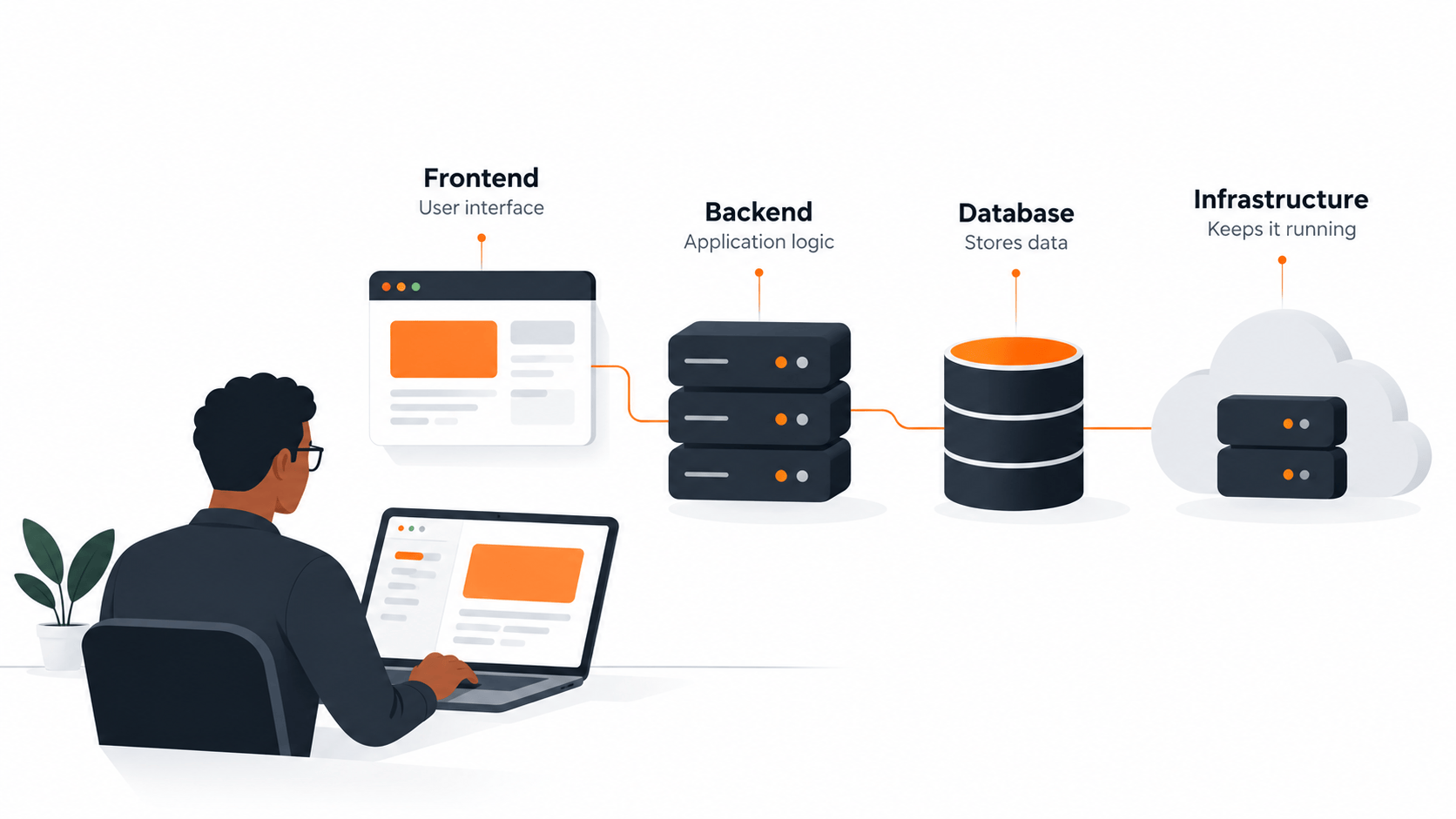
Every web application, from an online booking platform to an enterprise management system, relies on several technologies working together. Developers call this combination a technology stack, or tech stack.
But when someone recommends React, Node.js, Python, Django, or .NET, what does that mean for the organization investing in the application?
The choice affects development costs, security, performance, scalability, and long-term maintenance. Understanding the options helps businesses make informed decisions rather than follow technology trends.
What Is a Tech Stack?
A tech stack is the combination of technologies used to build, operate, and maintain a website or application.
Most web applications have four main layers:
- Frontend: The interface users interact with.
- Backend: The logic that processes requests and manages operations.
- Database: Where application information is stored.
- Infrastructure: The servers and cloud services that keep everything running.
For example, an appointment booking application might use React for its interface, Node.js for processing bookings, PostgreSQL for storing records, and a cloud server for hosting.
Different technologies can perform these roles. Here are seven approaches worth understanding.
1. MERN Stack: JavaScript Across the Application
Technologies: MongoDB, Express.js, React, Node.js.
MERN allows developers to use JavaScript or TypeScript across much of an application. React handles the interface, Node.js and Express manage backend requests, and MongoDB stores information in documents.
Best suited for: Interactive dashboards, collaboration platforms, startups, and applications with evolving data structures.
Real-world example: Netflix has documented its extensive use of Node.js for web-facing services since 2015. This demonstrates Node.js at scale, although it does not mean Netflix uses the complete MERN stack.
Consideration: Applications with complex financial relationships may benefit from a relational database such as PostgreSQL instead of MongoDB.
2. MEAN Stack: Structured Frontend Development
Technologies: MongoDB, Express.js, Angular, Node.js.
MEAN resembles MERN but replaces React with Angular, a comprehensive frontend framework.
Angular provides established conventions for forms, navigation, dependency injection, and organizing application code.
Best suited for: Enterprise dashboards, administrative portals, and applications maintained by teams familiar with Angular.
Real-world example: Google Cloud Console has used Angular for its web interface. This illustrates Angular in a complex application, not necessarily the complete MEAN stack.
Consideration: Angular's structure can help larger teams maintain consistency, although it introduces conventions developers must learn.
3. Next.js, Node.js, and PostgreSQL: Modern Full-Stack Applications
Technologies: Next.js, React, TypeScript, Node.js, PostgreSQL.
Next.js builds on React, providing capabilities for interactive interfaces, server-rendered pages, and backend endpoints. PostgreSQL manages structured data and relationships.
Best suited for: SaaS platforms, subscription services, customer portals, and management applications.
Real-world example: Notion's engineering case study, published with Vercel in November 2024, describes using Next.js for its marketing website and experimentation workflows. It does not establish PostgreSQL as part of that specific implementation.
Consideration: Next.js simplifies several development tasks, but database design, security, monitoring, and deployment still require careful planning.
4. Python and Django: Structured Business Applications
Technologies: Python, Django, PostgreSQL, optionally React.
Django is a Python framework that provides built-in tools for authentication, database management, and administrative interfaces.
It is useful when an application requires substantial backend functionality and structured business processes.
Best suited for: Content platforms, education management systems, operational applications, and data-driven services.
Real-world example: Instagram adopted Python and Django during its early development and has discussed scaling Python across its engineering infrastructure.
Consideration: Django's built-in capabilities can accelerate development, but scaling still depends on sound architecture and infrastructure.
5. Python and FastAPI: APIs, Automation, and AI Integration
Technologies: Python, FastAPI, optionally React and PostgreSQL.
FastAPI is a Python framework for building APIs that connect applications, process information, and deliver services.
It works particularly well alongside Python's data processing and machine learning ecosystem.
Best suited for: AI integrations, prediction services, data processing, automation, and backend APIs.
Real-world example: Netflix developed Dispatch using FastAPI, while Uber documented using FastAPI to serve predictions through its Ludwig machine learning project.
Consideration: FastAPI is not artificial intelligence. It can connect an application to AI models, but applications can also integrate AI using JavaScript, .NET, or other technologies.
6. ASP.NET Core and SQL Server: Enterprise Systems
Technologies: C#, ASP.NET Core, SQL Server, optionally React or Angular.
ASP.NET Core is Microsoft's framework for developing web applications and APIs. SQL Server provides relational data management.
Best suited for: Corporate applications, financial systems, internal portals, and organizations invested in Microsoft technologies.
Practical example: A financial institution could use this architecture for approvals, transaction records, and management reporting.
Consideration: .NET is cross-platform. Applications can run on Linux or Windows and do not necessarily require Microsoft Azure.
7. LAMP Stack: Established Web Publishing Infrastructure
Technologies: Linux, Apache, MySQL, PHP.
LAMP is a longstanding approach to building and hosting database-driven websites.
It remains relevant for websites that prioritize content management and reliable publishing.
Best suited for: Business websites, publishing platforms, content management systems, and traditional web applications.
Real-world example: WordPress, first released in 2003, uses PHP and MySQL-compatible databases and is commonly deployed on LAMP-style infrastructure.
Consideration: An established technology is not automatically outdated. A mature publishing platform may be more economical than building a custom application.
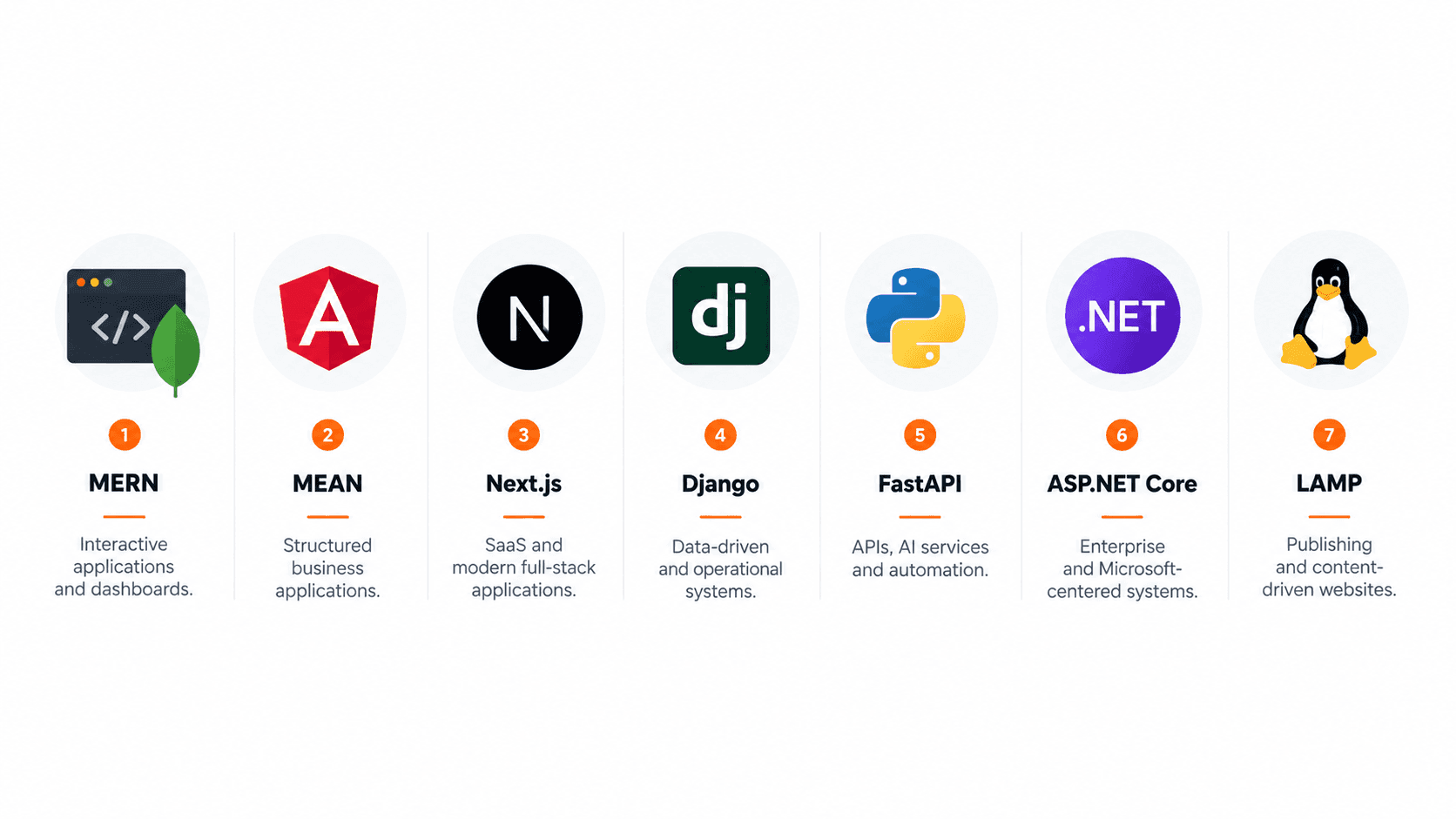
Comparing the Seven Tech Stacks
Tech stack | Typical use case |
|---|---|
MERN | Interactive applications and dashboards |
MEAN | Structured Angular-based applications |
Next.js + PostgreSQL | SaaS and relational business applications |
Django + PostgreSQL | Data-driven and operational systems |
Python + FastAPI | APIs, AI services, and automation |
ASP.NET Core + SQL Server | Enterprise and Microsoft-centered systems |
LAMP | Publishing and content-driven websites |
These are examples of where each approach may fit, not exclusive rules.
What About Cloud Hosting and Costs?
A technology stack determines how an application is built. Cloud infrastructure determines where it runs and how it is operated.
The same application may run on a virtual private server, managed hosting, or a container-based cloud platform.
When evaluating costs, consider more than the initial development quotation. Hosting, security updates, backups, monitoring, maintenance, and future upgrades all contribute to the total cost of ownership.
The cheapest approach to build is not always the cheapest to maintain.
Five Questions to Ask Before Choosing a Tech Stack
- What problem must the application solve? Start with business requirements, not technology preferences.
- What information will it manage? Sensitive records, financial transactions, and complex relationships influence architecture.
- Who will maintain it? Consider the availability of developers and operational expertise.
- How might it grow? Plan for realistic expansion without overengineering.
- What will it cost over three to five years? Include infrastructure, support, security, and future development.
These questions help organizations evaluate technology investments beyond initial development costs.
Frequently Asked Questions
What is the best tech stack for web development?
There is no universally best stack. The appropriate choice depends on project requirements, developer expertise, data structures, and long-term maintenance.
Is Python better than JavaScript for web development?
Neither is universally better. JavaScript and TypeScript are widely used for interactive web applications, while Python is especially useful for backend development, data processing, and machine learning.
Do I need Python to integrate AI into my application?
No. Applications built with JavaScript, TypeScript, C#, and other languages can connect to AI services through APIs.
Is PostgreSQL better than MongoDB?
PostgreSQL is often suitable for relational data and transactional workflows. MongoDB can be useful for document-oriented applications with flexible data structures. The application's requirements should determine the choice.
Final Thoughts: Choose Technology Based on Value, Not Hype
The technology landscape changes constantly, but good architectural decisions begin with the same questions.
Does the application solve the intended problem? Can it protect information? Can the organization maintain it? And does the investment deliver lasting value?
The best tech stack is not necessarily the newest or most popular. It is the one that meets the application's real requirements without introducing unnecessary complexity.
References & Further Reading
- OpenJS Foundation — The Evolution of Node.js at Netflix
- Angular — Official Framework Documentation
- Vercel — How Notion Powers Rapid Experimentation
- Instagram — Python at Instagram, PyCon 2017
- FastAPI — Official Documentation and Adopters
- Microsoft — ASP.NET Core Documentation
- WordPress — Official Hosting Requirements