What Communications Interviews Really Test: Strategy & Impact
What do communications interviews really test? Explore practical lessons in communication strategy, storytelling, social media, fundraising, and measuring impact.

Beyond creating content and managing social media, what does it really take to become an effective communications professional? Reflections on strategy, digital storytelling, fundraising, and measuring communication success.
Imagine attending an interview for a communications role and being asked a seemingly straightforward question:
"If your organization's social media impressions increased by 60%, but donor engagement remained unchanged, would you consider your communications strategy successful?"
At first, the answer might appear obvious. A 60% increase in impressions suggests that more people are encountering your organization's content. Surely, that is progress.
But what if those impressions aren't translating into meaningful relationships, partnership opportunities, or support for the organization's work?
Would you still consider the strategy successful?
It's an interesting question because it challenges how we define communication success. More importantly, it reveals something about what employers are looking for when interviewing communications professionals.
Having attended interviews for communications roles and worked on communication strategies, digital storytelling, social media management, and organizational visibility, I've increasingly come to appreciate that effective communication requires much more than creativity or familiarity with digital platforms.
It requires an understanding of organizational priorities, audiences, human behaviour, and how communication contributes to meaningful outcomes.
In this article, I want to explore five lessons drawn from practical experience that can help anyone preparing for a communications interview, developing a communication strategy, or looking to strengthen their approach to organizational communication.
1. A Good Communication Strategy Begins With Understanding the Organization
One question that frequently arises during communications interviews is:
"How would you develop a communication or social media strategy for our organization?"
It's tempting to begin by discussing content calendars, social media platforms, campaign ideas, or tools for managing publications.
However, my experience has taught me that developing a communication strategy should begin much earlier.
Before deciding what to communicate, we need to understand why the organization needs to communicate in the first place.
What does the organization do? Who benefits from its work? What are its priorities? Who are its key audiences? How does it currently communicate, and what does it consider success?
For a nonprofit organization, the objectives might include attracting funding, strengthening partnerships, communicating programme impact, influencing policy, or engaging communities.
For a commercial organization, communication might support customer acquisition, brand visibility, customer confidence, or business growth.
These objectives determine the direction of the communication strategy.
My approach to developing a communication strategy
When approaching a new communications assignment, I prefer beginning with an assessment of the existing environment. This involves understanding the organization's programmes, reviewing its previous communication activities, identifying the audiences it serves, and examining what has worked and what hasn't.
I also try to understand the relationship between communication and other organizational functions, particularly programme implementation, management, fundraising, and stakeholder engagement.
This assessment shouldn't necessarily delay action for several months. An initial review can be completed within a few weeks, depending on the organization's complexity and the information available.
The findings then inform a strategy that defines communication objectives, priority audiences, key messages, channels, responsibilities, resources, and performance indicators.
My preference is to establish an initial implementation period of approximately three months, during which we monitor performance, identify challenges, and refine our approach. From there, the organization can adopt a longer-term strategy supported by regular performance reviews.
One lesson I've learned is that a communication strategy shouldn't become a document that sits on a shelf after management approves it. It should guide decisions, inform implementation, and evolve as the organization learns.
The practical lesson: An effective communications professional doesn't begin by asking what to post. They begin by understanding what the organization wants to achieve and how communication can contribute.
2. Effective Content Planning Begins Before You Pick Up a Camera
Another question frequently asked during communications interviews concerns content creation and management.
"How do you plan, develop, and publish content for an organization?"
For someone working in digital communications, the answer might involve content calendars, photography, video production, copywriting, graphic design, and social media scheduling.
All these activities are important. However, I believe the quality of organizational content is often determined long before it reaches the publishing stage.
In development communications, for instance, collecting content from the field requires more than taking attractive photographs or recording interviews.
You need to understand the programme, its objectives, the people it serves, and the changes it intends to create.
What working with digital inclusion programmes taught me
Through my communications work with Hello World, I've had opportunities to develop content that demonstrates how communities use digital technology to access information, strengthen learning, and develop practical skills.
One observation from managing the organization's LinkedIn communications is that evidence-based content, particularly personal experiences and participant testimonials, tends to generate stronger engagement than content that simply describes programme activities.
Consider two ways of communicating the same intervention.
The first might explain that an organization installed a solar-powered digital learning facility in a community.
The second might introduce a learner who uses that facility to access educational resources, explaining what they have learned and how the opportunity has affected their experience.
Both messages communicate programme information. However, the second provides a human perspective that audiences can more easily understand and relate to.
This observation has influenced how I approach content collection.
When preparing for field documentation, I think about the information needed to communicate both the intervention and its value. That might involve identifying potential interview participants, preparing relevant questions, documenting activities, collecting meaningful quotations, and capturing visuals that support the story.
The objective is not simply to return from the field with photographs and videos. It is to collect material that helps explain what is happening, why it matters, and what evidence supports the story.
This has also changed how I think about content calendars.
Instead of developing a publishing schedule independently of programme implementation, I try to connect content planning to ongoing activities, expected outcomes, and opportunities to document meaningful experiences.
The practical lesson: Strong communication begins with intentional information gathering. What you collect determines the quality of the stories you can eventually tell.
3. Visibility Is Important, but It Isn't the Same as Impact
Let's return to the question about a 60% increase in impressions without a corresponding increase in donor engagement.
Would I consider that successful?
My answer would be that the strategy has achieved partial success.
Increased impressions may indicate progress towards awareness objectives. However, if the organization's broader objectives include generating meaningful stakeholder engagement, attracting partners, or supporting fundraising, then we need to examine whether that increased visibility is creating opportunities for those outcomes.
This distinction is particularly important in nonprofit and development communications.
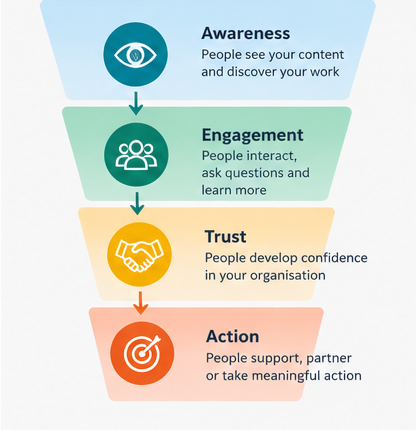
Communication and fundraising are often long-term activities. Someone might encounter an organization through social media today, visit its website several weeks later, and only initiate contact after developing sufficient interest and confidence.
Therefore, the absence of immediate conversions doesn't necessarily mean a communication strategy has failed.
At the same time, we shouldn't use the long-term nature of fundraising as an excuse to avoid evaluating performance.
A practical experience connecting LinkedIn visibility to fundraising
In 2023, I led the development of a communication and marketing strategy for Hello World, working with colleagues to support its implementation.
Part of the strategy involved using digital channels to communicate programme activities, organizational priorities, and impact more consistently.
One particularly interesting outcome involved a donor who later explained how they had discovered the organization.
Their journey began on LinkedIn, where they encountered Hello World while searching for information. They subsequently visited the organization's website, explored its work, and initiated contact.
That engagement eventually developed into a significant funding contribution.
What I found particularly valuable about this experience wasn't simply the eventual financial support. It was understanding the role that different communication channels had played in the donor's discovery and engagement journey.
LinkedIn provided an initial point of discovery. The website offered an opportunity to explore the organization's work in greater depth. Subsequent engagement created the opportunity to build a relationship.
Of course, it would be inaccurate to suggest that a single LinkedIn post secured the funding. Fundraising involves relationships, engagement, due diligence, and other organizational efforts.
However, the experience demonstrated how communication can contribute to the process.
Measuring what matters
When evaluating social media performance, I use platform analytics, such as LinkedIn Analytics, to understand impressions, reach, engagement, and audience growth.
Google Analytics can help assess website traffic, referral sources, and relevant visitor actions, provided the appropriate tracking has been configured.
However, these metrics need to be interpreted against organizational objectives.
A useful distinction is between communication outputs, audience outcomes, and organizational impact.
Outputs include activities and their immediate results, such as published content, reach, and impressions. Outcomes concern changes in audience understanding, attitudes, engagement, or behaviour. Impact considers how communication contributes to broader organizational objectives, including stronger relationships, increased support, or positive social change.
This approach is reflected in the AMEC Integrated Evaluation Framework, which encourages communications professionals to connect measurement with meaningful outcomes.
In practical terms, I believe communication reporting should help management understand not only what was published and how it performed, but also what was learned and what decisions should follow.
The practical lesson: High impressions may indicate visibility, but communication success must ultimately be evaluated against the objectives it was intended to support.
4. Powerful Storytelling Requires Responsibility, Not Just Creativity
Storytelling is an important part of effective communication, especially when working with communities, children, and vulnerable populations.
Yet one of the most important questions a communications professional should ask isn't simply whether a story is compelling.
It's whether the story can be communicated responsibly.
In development communications, the desire to demonstrate impact can sometimes create pressure to capture emotional photographs, powerful testimonials, or personal experiences that attract attention.
However, the responsibility to protect the people involved should always take precedence over producing engaging content.
Balancing storytelling with safeguarding
When documenting programmes involving children, my approach begins with understanding the applicable safeguarding requirements and obtaining the necessary informed consent, including parental or guardian consent where appropriate.
School or institutional permissions may also be required, but they don't replace the need to respect the child's rights, wishes, and best interests.
Importantly, consent alone doesn't automatically make publication appropriate. We must still consider whether identifying someone could expose them to stigma, unwanted attention, or other risks.
There are situations where photographs may not be appropriate, even when the experience being communicated is valuable.
In such cases, alternative creative approaches can help explain a programme's impact without unnecessarily exposing individuals.
These might include illustrations, anonymized experiences, carefully selected contextual visuals, or descriptions that focus on the intervention rather than identifying the participant.
The same consideration applies to quotations. A quotation can communicate an experience without necessarily revealing the identity of the person who shared it. However, anonymity must be meaningful, and any public quotation should be accurate and appropriately authorized.
These considerations are consistent with UNICEF's ethical reporting guidelines, which emphasize dignity, privacy, informed participation, and protection from harm when reporting on children.
For me, ethical storytelling is not an obstacle to effective communication. It is part of what makes communication credible and responsible.
The practical lesson: A compelling story should never come at the expense of the dignity, privacy, or safety of the people whose experiences we communicate.
5. Good Communications Professionals Know When to Adapt
One of the most useful lessons I've learned from managing organizational social media is that what works for one organization, audience, or platform may not necessarily work for another.
For example, some of the strongest content I've observed on Hello World's LinkedIn involves personal experiences, testimonials, and evidence demonstrating programme value.
I've also observed that video content hasn't consistently performed as strongly on that particular LinkedIn account as some other formats.
However, my experience publishing videos on YouTube for my own digital storytelling work has been different. Some videos have attracted between 1,000 and 2,000 organic views without paid promotion.
This doesn't necessarily mean YouTube is better for video content or that LinkedIn audiences don't appreciate videos.
It means content performance is influenced by several factors, including audience interests, topic relevance, presentation, distribution, and platform-specific behaviour.
Early performance indicators can provide useful signals, but they don't always predict long-term results.
Different organizations require different content approaches
In my communications work with Proxima Solutions Limited, I've observed the value of content that demonstrates practical expertise.
For a business involved in technical installations and security solutions, showing technicians at work, documenting installations, explaining solutions, and presenting aspects of the customer experience can make its expertise more tangible.
A photograph or video showing how an access control system is installed may communicate something different from a promotional graphic describing the same service.
The field-based content gives audiences an opportunity to see the work being carried out.
However, such content should be supported by accurate explanations and, where possible, verified customer feedback. Showing an installation is evidence of activity, but demonstrating reliability or customer satisfaction requires additional evidence.
This understanding helps determine what content to collect, how to present it, and where to publish it.
It also highlights why communications professionals need to remain curious about audience behaviour.
The role of technology and communication tools
Tools make implementation more efficient, but they cannot replace strategic judgment.
In my workflow, I've used resource planning systems to understand project activities, responsibilities, and deliverables, alongside platforms such as Buffer and previously Hootsuite for social media scheduling.
Analytics tools help identify performance patterns, while content management and production tools support the development and publication of material.
Yet the important question isn't how many tools a communications professional knows how to use.
It's whether they can use the available information and resources to make better communication decisions.
A scheduling tool can help publish content consistently, but it cannot independently determine whether the message is relevant to the audience. An analytics dashboard can show declining engagement, but it takes interpretation to understand the possible reasons and decide what to change.
This is where experience, critical thinking, and continuous learning become particularly valuable.
I prefer reviewing performance regularly, examining what resonates with audiences, identifying gaps, and using those insights to improve content planning and implementation.
An annual communication strategy can provide direction, but quarterly reviews create opportunities to learn and adapt without abandoning the organization's broader objectives.
The practical lesson: The value of a communications professional lies not simply in using tools, but in making informed decisions about audiences, messages, channels, and organizational priorities.
So, What Are Communications Interviews Really Testing?
Reflecting on these experiences, I believe many communications interview questions are designed to explore something deeper than technical knowledge.
When an interviewer asks how you would develop a communication strategy, they are assessing whether you understand organizational objectives and can translate them into a practical plan.
When they ask how you manage social media, they want to understand whether you can develop relevant content, engage audiences, evaluate performance, and improve your approach.
When they ask how you measure success, they are testing your ability to distinguish activity from results and explain the value of communication to an organization.
And when they present a difficult scenario involving sensitive information, reputational risk, or vulnerable people, they are evaluating professional judgment and ethical responsibility.
These questions are interconnected because effective communication is itself an interconnected process.
Research informs strategy. Strategy guides content development. Content reaches audiences through appropriate channels. Performance data generates insights. Those insights inform future decisions.
The cycle continues as organizations learn more about their audiences and operating environments.
How should you prepare for a communications interview?
Rather than memorizing answers to dozens of questions, I would encourage aspiring communications professionals to reflect on the situations they have encountered and the decisions they have made.
Think about a time you developed a strategy, managed a campaign, addressed a communication challenge, or used performance data to make an improvement.
What was the organizational objective? What approach did you choose? Why did you choose it? What happened? What did you learn, and what would you do differently?
Even when an initiative doesn't achieve its intended results, the experience can demonstrate valuable professional judgment if you can explain how you evaluated the situation and responded.
The objective isn't to present yourself as someone who has never encountered difficulties. It is to demonstrate that you can approach problems thoughtfully, make evidence-informed decisions, and take responsibility for outcomes.
For someone entering the profession, examples can also come from internships, volunteering, academic projects, community initiatives, or independent work. What matters is being truthful about your contribution and able to explain your reasoning.
Final Thoughts: Communication Is More Than Visibility
Over time, my understanding of effective communication has evolved.
While content creation, social media management, photography, video production, and digital tools remain important parts of my work, I've increasingly come to appreciate their role within a much broader organizational context.
A compelling story can help people understand an intervention. A well-developed website can help an interested stakeholder explore an organization. A consistent social media presence can create opportunities for discovery and engagement.
But the real value emerges when these activities work together to support meaningful organizational objectives.
For communications professionals, that requires a combination of creativity, research, analytical thinking, ethical judgment, and the willingness to adapt.
For organizations, it means recognizing communication as a strategic function rather than simply a publishing activity.
And for anyone preparing for a communications interview, perhaps the most useful question to ask isn't whether you know how to create a successful social media post.
It is whether you understand how communication creates value, how to evaluate that value, and how to make informed decisions when the results aren't what you expected.
That, in my view, is what separates knowing how to communicate from understanding the strategic value of communication.
This article draws on practical experience in development communications, social media management, digital storytelling, and organizational communication strategy, alongside established professional guidance on communication measurement and ethical storytelling.